
How I Think About Dance & Cultural Transmission.
Updated: May 23
Musings about a community that eats itself alive and wonders why there is nofresh blood.
This blog was inspired by a Facebook post I saw recently. Someone was asking whether anyone had ever argued with them about the technique of the maya— whether it should go up first or down first. There was a whole thread going. People had opinions. Strong ones apparently.
I just sat there thinking: why would you argue about this? Just do it how you like to do it and move on with your life.
And that thought led me here — to this blog, to trying to explain the kind of osmosis I want to offer on my upcoming tour, and to giving you a glimpse into how I actually think about dance. If you haven’t heard of me, or haven’t heard from me in a while, welcome back. There are things I want to say.
-----

I was never particularly interested in the great bellydancer war.
Classic versus tribal — the great bellydance debate that swallowed years of Facebook comment sections and made grown women act like they were defending actual territory. I didn’t ignore it completely — I would chime in here and there, drop a sarcastic comment, observe the chaos. What were they going to do, cancel me? I’m Egyptian. I trained at the Salimpour School and at Fat Chance Belly Dance for American Tribal Style, at the same time, without a moment of genuine internal conflict. AAAnd had a career in the alt arts scene. I could not be bothered. The argument always struck me as petty and largely meaningless. I wanted to move my body and look beautiful ( or terrifying.) . That was the whole point. That was always the whole point.
You’ll also notice, if you’ve been watching my page for any length of time, that I don’t have dance videos plastered all over my feed. There is a lot going on — but my actual dancing is not what I showcase online. That’s intentional. Since moving to Egypt, my dance has become purely mine. I still teach private lessons and workshops. But I’ve deliberately concentrated my own energy away from eyes that judge and think they know, when they have no idea. What I do with my body in a room has become something I protect. You’ll understand why as you keep reading.
I need to back up though, because I should tell you why dance even mattered to me in the first place — because it’s not what most people assume.
Why I Actually Got Into This (How is another story for later)
I didn’t get into dance or specifically bellydance for the stage. I got into it because for the first time in my life I felt complete agency and control over my own body, in minute detail. That feeling — I have not found it anywhere else. Not in anything I’ve tried before or since. It made me feel powerful in a way that was entirely mine. It allowed me to experience myself as feminine and beautiful, on my own terms, without asking anyone’s permission.
I’m the oldest of seven. My father was a very traditional, very oppressive Egyptian man. Growing up, the safest energy for me to inhabit was tomboyish — and like many women, I leaned into that not just as personality but as a kind of protection. You mask. You make yourself smaller and harder and less of a target. You do what you need to do inside a patriarchy that doesn’t give you many good options.
Women in North America carry a particular version of this weight. You work full-time, you run a household, you manage everyone else’s emotional world, and somewhere in all of that, your own femininity — your own sense of yourself as a woman, your own pleasure in your body — gets quietly deprioritized until you can’t even find it anymore. It doesn’t happen dramatically. It just disappears.

Dance gave me a way back to myself. My dedication to technique, to refinement, to the relationship between my body and music — that was a personal excavation. Not performance. Not approval. Not a costume or a stage. Just me, discovering what I was capable of feeling in my own skin.
That’s the foundation. Everything else built on top of that.
"The School "Years
The Salimpour School gave me a lot. Real technique. A serious framework. I made it all the way to (almost) Level 4, which takes years and genuine commitment. But by the time I got there, the gatekeeping had gotten louder than the learning. There were people at that level who didn’t like me personally, and they made sure I knew it. The political games, the high school dynamics dressed up as professional standards — I’d seen enough of it in the wider dance world and I was genuinely annoyed to my wit’s end with it.
My school, like many in the performance-focused bellydance world, put enormous emphasis on the nightclub setting, the costume, the visual spectacle of the art form. And I understand that. A costume can do a tremendous amount. Presentation matters. I’m not naive about any of that.
But when performance labs started piling on stress rather than joy, when the creative process started to feel over-governed, when I felt like I was indebted to an institution’s approval for my own development as a dancer — I recognized that signal. My expansion as a woman has never been dependent on the validation of external certifying bodies. I didnt want to feel like a child getting in trouble, I'm a fucking woman.
I enjoy improvising with live bands. I enjoy deep technique work. What I don’t enjoy is having my creative process managed by people who are more interested in gatekeeping than in the actual art. So in 2019, I left. Not quietly — it was a bit of an exit — but I left with everything I’d actually gone there to get and without the parts that were never worth the cost.
I had also been running a dance and yoga school in Canada for over 12 years. I had built something real. And then I walked away from it all and started over in Egypt. More on that in a moment.

Teaching Tribal in Egypt (Yes, Really)
When I moved to Egypt, I had a problem I hadn’t fully anticipated. I was a bellydance teacher. Egypt already has bellydance teachers. Excellent ones. The kind of classical instruction I’d been offering in the West? Not remotely needed here. There is no shortage of people who can teach Egyptian style to Egyptians in Egypt.
So I thought about what I could actually offer that was distinct, useful, and interesting. And what kept coming back to me was this: teach American Tribal Style. In Egypt.
I’m not going to pretend I didn’t enjoy the quiet irony of this. Every time I stood in front of a class, I was thinking about all the years of Facebook debates, all those Western dancers arguing in comment sections about whether tribal was a “legitimate” form of bellydance, whether it was appropriation, whether it honored the art form or corrupted it. And there I was, Egyptian, in Egypt, teaching it. Make of that what you will.

What I will say is this: if we’re running legitimacy checks, most people typing those arguments from their living rooms in Ohio are not going to pass them either. The self-appointed gatekeepers of cultural authenticity are rarely the people with the most actual cultural proximity. This is something you learn quickly when you live here.
The teaching itself was genuinely joyful. But the circumstances around it were — complicated.
The Hijab Phase
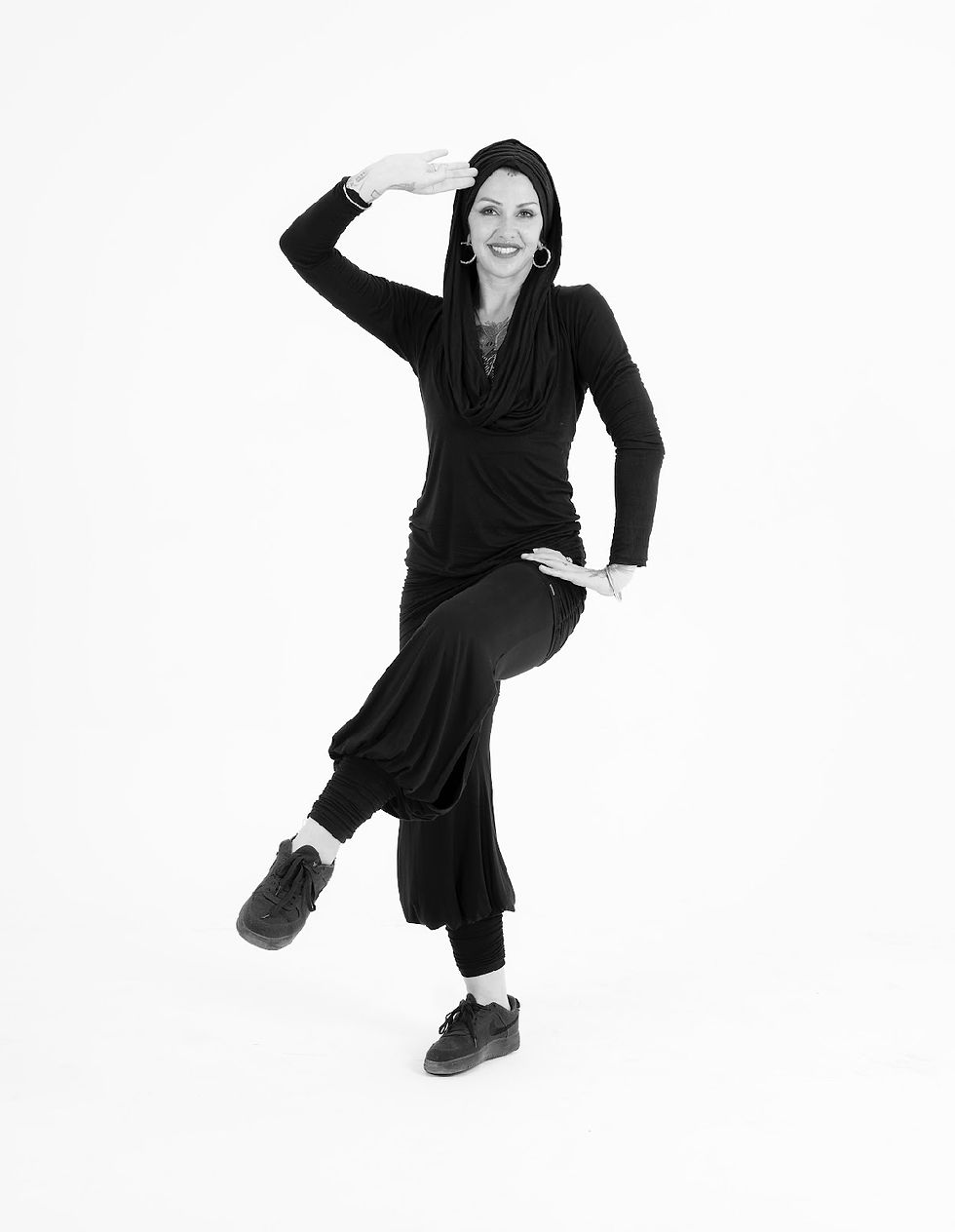
I was also, during this period, in my hijab phase. Which made the marketing situation genuinely chaotic in ways I had not fully prepared for.
The studio I was working with wanted to put videos of me online. Specifically, videos of me in a revealing costume, which is fairly standard marketing for bellydance studios. I explained that this was not going to be suitable for me. They pushed back. We went back and forth for a while. We eventually parted ways.
Several studios followed. Contemporary spaces, more traditional ones, various combinations. Each had something that eventually became untenable. If anyone who has spent time in Egypt is reading this, they’ll understand immediately when I say: the relationship with punctuality was enough to drive me to my wit’s end. I cannot function in an environment where students show up thirty minutes late and then proceed to make themselves a cup of tea before class. I just cannot. I have tried. I’m not built for it.
There was also a dance movement therapy program I invested in — years of it, real money, real time. The organizers hadn’t fully developed the concept before they launched it. My peers in the program were not serious. The whole thing had the shape of something meaningful without the substance. I stayed longer than I should have, hoping it would become what it had promised to be. It didn’t.
The final straw in this particular chapter of misadventures: I did a dance retreat in Italy. One of the organizers — the husband, who was also the photographer — offered to film a video for me. With his iPhone 15. For €300.
That was the moment I understood clearly that I had ended up in the wrong ecosystem entirely.
Coming Back
I crossed an ocean back to my original communities. The ones I’d built over years in North America before I’d essentially dropped off the face of the earth.
I won’t romanticize this part — there was real anxiety in it. I had been gone long enough that I didn’t know if anyone would remember me. Why would they care? I had disappeared. I had left my school, left my communities, left everything I had spent twelve years building. The disappearing syndrome, I started calling it in my own head. The particular discomfort of having to reintroduce yourself to people who once knew you, not knowing what version of yourself they’ll find when you show up again.
But I showed up. And I kept showing up. And still showing up.
What Living Here Actually Teaches You
Here’s something that’s hard to explain to people who haven’t been here: Egypt is not what you think it is, and not what you’ve been taught, and not what a dance tour or two — however excellent — will show you.
Old civilizations are layered in ways that take years, real relationships, and a high tolerance for complexity to begin to understand. The things that seem contradictory or confusing from a Western framework often make complete sense once you’ve been here long enough to see what’s actually underneath them.

Take the conversation around the word “gypsy” — I used to be one of the bellydancers making sure everyone knew it was an ethnic slur. And in many contexts, that’s a conversation worth having. But when you’re actually in Egypt, where there are actual Romani and Ghawazee communities actively using this word for themselves — the question becomes a different one. Do I stand in front of people and tell them they’re using their own identity incorrectly? Who exactly am I protecting, and from what? The Western framework around this, however well-intentioned, doesn’t translate cleanly.
Or the Amazigh. There are Amazigh people living in Egypt who are not Egyptian. That sentence sounds impossible until you understand the history. It’s just one example of how much complexity exists underneath what looks, from the outside, like a single coherent culture.
A Facebook group about bellydance does not prepare you for any of this. One tour might crack the door open. That’s not a criticism — it’s just honest about what’s possible in a short time. The door cracking open is valuable. It’s more than most people ever get.
What This Tour Actually Is
I want to be clear about what I’m offering, because I think it’s genuinely different from other Egypt dance experiences — and I say that without apology, because I’ve spent years building what makes it different.
The word I keep coming back to is osmosis. Not a workshop. Not a certification program. Not a masterclass with someone who visits Egypt twice a year. Osmosis — the kind of absorption that happens when you are actually inside something, surrounded by it, being received by people who live it. That’s the experience I’m trying to create.
The relationships I bring you to — the dancers, the musicians, the spaces — those took years to develop. Trial and error. Wrong turns. A hijab phase. A €300 iPhone offer that clarified exactly what kind of people I did not want in my professional life. I found my way here the hard way, and I’m still finding it, which is the honest version of what it means to build a life in a place that is not easy.
I am also Egyptian. This is not a Western dancer who visits Egypt regularly and has genuine love for the culture. I am from here. I hold the culture from the inside. The translation I offer — between your dance practice and the place it comes from, between what you’ve been taught and what’s actually true — comes from that position. I don’t know of another person offering this specific combination. Specifically to the Fusion dancer world. I am a fusion dancer, SO I understand how you think and process, and am able to translate the culture to digestable segments of understanding.
But here’s the other thing, the thing that matters maybe even more than the cultural context:
"This tour is for people who want to dance for joy. Full stop."
The Part About Enjoyment
(Which Shouldn’t Need Defending But Apparently Does)
In the West — and I say this as someone who lived there for most of her life — we have a deeply uncomfortable relationship with doing things just because we love them.
You pick up a hobby and immediately you feel the pressure to justify it. To explain what it’s for. To demonstrate that you’re good enough at it. And then, eventually, to monetize it — because in our framework, the thing you love doesn’t have full legitimacy until someone is paying you for it. It’s an extraordinary trap. And it quietly ruins a lot of people’s relationships with the things they love.
I want to say something clearly: it is wonderful if you can make money from your passion. Truly. But monetizing something changes your relationship with it in ways you don’t always anticipate. Sometimes you turn around one day and realize you’ve forgotten what passion even felt like, because the thing you loved is now a job with deadlines and deliverables and an audience to please.
My own deepest measure of contentment — and I mean this completely seriously — is being in a room full of people and laughing at a joke I told only to myself, in my own head. That internal world, that private delight, the capacity to be entirely sufficient to yourself — that’s what I’m chasing. That’s what I’d like to offer people a version of.
Whether you perform your dance or you have never once stepped on a stage and have no intention of doing so, you belong here. Whether you have fifteen years of training or you’re figuring it out as you go, you belong here. The criterion is not your level or your ambition. It’s whether you want to be somewhere that treats dance as a living thing rather than a credential.
One More Thing About Egypt
Egypt is not easy. The bureaucracy, the time, the noise, the heat, the negotiating, the constant recalibration of your expectations — it asks a lot of you.
But there is nothing in my experience that compares to the expansion that happens when you are genuinely welcomed by people who have a completely different framework for being alive. Not as a tourist. Not as a student paying for access. As someone who is actually being received.
No certification from any top dancer, no matter how prestigious the name, gives you that. I promise you. If you’re thoughtful, if you want to dance more, if you want to be around people who are dancing because they’re alive and not because they’re seeking approval — you’ll understand what I mean once you’re here.
Yalla April 7th-19th 2021 In Cairo.
Questions about the tour? Get in touch.


Comments